
The most important feature of a destination website never gets talked about

Kinnon is the Chief Creative Officer at our sister company, The New Business, a tourism marketing company that specializes in creative campaigns, branding, and destination websites. Our team asked her to share what has changed about their design process once they started building websites with Whereabouts.
Even after working on website projects at The New Business for well over a decade, I still get excited by that first “discovery” call with a new client. I love it when the team hears the client’s goals, dives into research about the destination, and starts dreaming of how it should look and feel.
So much work goes into planning out the website structure, functionality, features, and above all, the visitor experience. How does this website take a visitor through the journey from first impression through to inspiration, planning, and eventually booking? We spend weeks discussing design mockups until they’re perfect. We build, we launch, we train, and we hand it off to our excited clients.
It’s only after the handoff do we realize we never talked about maybe the most important website feature of them all: maintainability.
Maintainability, while maybe a bit of a mouthful, isn't a boring operational footnote. It's actually a design principle, and it's an incredibly important one for destination websites.
The real test for a “good” destination website
At my job, I think a lot about what makes a design “good.” Aesthetics matter, obviously. So does functionality, and accessibility. But the test I keep coming back to is simpler than any of those: does it keep working for the person using it, over time, in the real conditions of their life?
A chair that looks beautiful but is uncomfortable to sit on isn't a good design for a cozy living room. A car that’s sleek and sporty but needs a lot of maintenance isn’t a good design for a family who needs a reliable vehicle. And a destination website that's stunning on launch day but requires a developer and hours of staff time to update a business listing isn't a good design for the average DMO.
A destination website that doesn’t take this into consideration is, in my mind, a failure.
The hidden cost of a hard-to-maintain tourism website
Imagine a visitor arriving at your destination website, somewhere on a spectrum between “I know nothing about this region” and “I’m planning a trip here next month.” A well-designed tourism website is full of inspiring and curated content that is easy to navigate and structured for discoverability.
But inspiration is only the beginning. At some point, a visitor needs to know where to eat, what's happening this weekend, which operators offer the experience they're looking for, and how to get there. That's where design needs to be grounded in data. And that only works if the data is accurate.
A beautifully designed events page with listings that are months out of date, or a stunning directory of local operators where links are broken or missing doesn't inspire confidence in the destination. In fact, it quietly erodes it.
The visitor experience your website is trying to create depends entirely on the accuracy of the information underneath it. Which means maintainability isn't separate from visitor-centered design.
The question every DMO should ask before building a new website
So how do we fix this? For starters, we can start to consider not only "what do we want this site to look like" and "what features do we need," but also what is the system that will keep this site accurate in six months, in twelve months, in two years?
Who updates the business listings when an operator changes their hours? Who adds new events when a partner submits them? Who removes the listings for businesses that have closed? Who keeps the photography current as the destination evolves?
If the answer to most of those questions is "one person on our team, manually, when they have time," then the website you're about to build has a structural problem that no amount of great design can solve.
But, but! If you think that I’m telling you to pick one over the other—that you can either have a stunning, feature-rich destination website or you can have something practical and easy to keep current, but not both—then let me introduce you to Whereabouts.
Beautiful and maintainable: how Whereabouts changes the equation
When the team at Whereabouts started showing us their software about a year ago, we knew almost immediately that this was going to fundamentally change how we thought about building websites.
Up until now, everything we designed was built only using a CMS, or content management system. We happen to use Payload, but you might be familiar with Wordpress or one of the other popular CMS platforms. Someone on the team would upload all of the content, images, business listings, and event info into the CMS to populate the pages. Sometimes, plugins would be needed for maps and event calendars. Someone would have to make sure those plugins were updated regularly, or even replaced if they broke or become obsolete. And when it was time to refresh or redesign your website? All of that content would have to be downloaded and manually transferred over to the new site.
Now, when we build a site that’s powered by Whereabouts, we’re never starting from scratch. Your written content, blogs and gorgeous videos are still published through the CMS, but your member directory lives in Whereabouts. Your events calendar runs through Whereabouts. Your operators manage their own listings, updating hours, photos, descriptions, and contact details directly, without routing anything through your team or your developer. When something changes, you approve it and it changes on your website automatically.
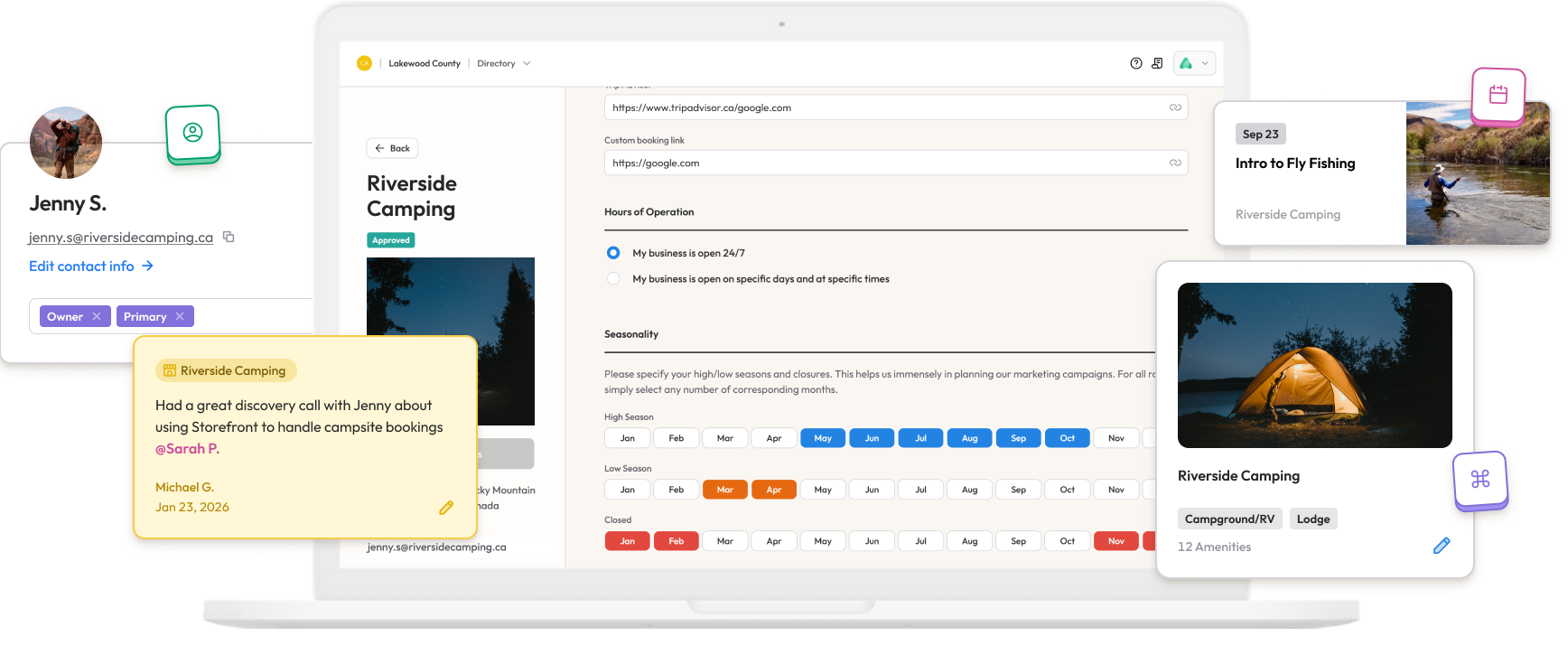
Which means the directory page stays accurate without anyone on your team manually touching it. The events calendar stays populated because operators are submitting their own events. The campaign landing page you built around a seasonal experience pulls live, current operator listings with perfectly sized photos.
Whereabouts was also designed to work with any CMS, so you’re never locked in to one platform. If you decide to redesign your site, all of your listings, events, and widgets come with you. None of that hard work is lost.
The website doesn't have to be simpler, or have fewer features to accommodate the practical reality of a small team. The Whereabouts infrastructure handles that. Your team gets to focus on the work that actually needs human judgment: the strategy, the storytelling, the relationships.
A website built this way does everything a great destination website should. It moves visitors from curiosity to confidence, from inspiration to a booked trip. It reflects well on the destination, the team behind it, and the work that went into building it. That's what good design is supposed to do.

